
How Internationalization at Home Opens Doors in Higher Education

When we talk about inclusivity in higher education, the conversation often focuses on physical accessibility, support services, or institutional diversity policies. These matter. But there is a structural barrier that rarely receives the same attention, and it is the assumption that a truly international education requires leaving home.
At GTSF, we believe this assumption is one of the most consequential equity gaps in higher education today and that addressing it is an act of inclusivity in itself.
Who gets left behind by traditional mobility models
International experience has long been treated as a marker of quality education. Study abroad programmes, exchange semesters, and in-person international conferences are seen as formative, career-defining opportunities. And they definitely are, but only for the students who can access them.
The reality is that the majority cannot. Financial constraints, family responsibilities, visa restrictions, health conditions, disability, and caregiving roles all function as invisible barriers that systematically exclude students from underrepresented or marginalised backgrounds. According to UNESCO’s first global Higher Education Trends report, fewer than 3% of students worldwide ever study abroad. Seven countries host half of all internationally mobile students. The system reproduces existing inequalities.
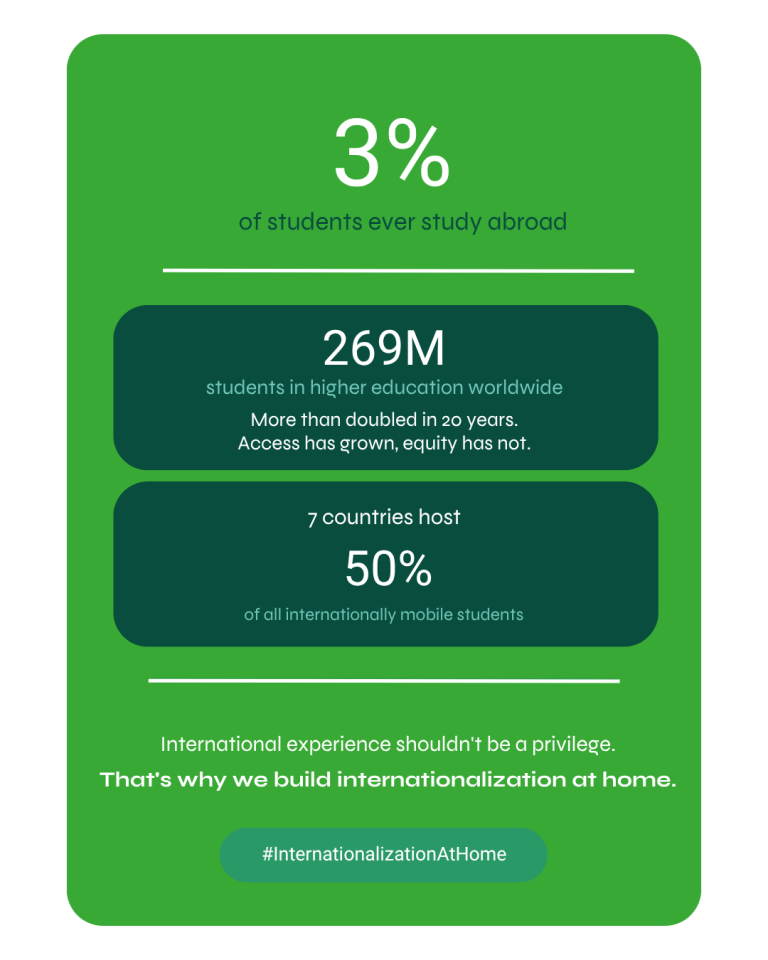
The GTSF Students Programme was built on the premise that cross-border, intercultural learning should be a right, not a privilege determined by economic or social circumstances.
Through virtual exchange, collaborative online international learning (COIL), and a deliberately intercultural pedagogical design, we brought together university students from Malaysia, Türkiye, Ukraine, Spain, Romania, and beyond without requiring anyone to travel. Students who cannot participate in traditional mobility programmes due to disability, financial barriers, visa constraints, or caring responsibilities can engage fully in an international learning experience from their own institutions. We believe this is a more equitable compromise version of internationalisation.
Inclusivity in the GTSF Students Programme shapes how the programme is designed and delivered. Our pedagogical framework draws on experiential and action-oriented learning approaches that value diverse forms of knowledge, cultural backgrounds, and ways of engaging with sustainability challenges.
The Thinking Glocally module, for instance, asks students to connect global sustainability challenges with their own local realities, a design choice that centres students’ lived experience rather than requiring them to adopt a single, dominant perspective. The Foundation Module builds a shared learning environment through relationship-first dynamics, creating the psychological safety needed for students from very different cultural and institutional contexts to collaborate effectively.
These features reflect a deliberate commitment to designing learning that works for a diverse, internationally distributed student population.
Why this matters beyond the programme
The GTSF model points towards a vision of higher education in which international and intercultural learning is embedded in how universities teach, not reserved for those who can afford to travel. As institutions across Europe and beyond work to meet SDG 4.7, which calls for education that promotes global citizenship and sustainable development, the question of who gets access to that education cannot be separated from how it is delivered.
Designing for inclusion from the start is not a constraint on quality. It is a precondition for it.